
Every fancy font you see online is really a set of Unicode characters. Once you know which characters they are, it gets much easier to understand why styled text sometimes breaks after you paste it.
Our Unicode fonts generator shows your plain text turning into bold, script, outline, fullwidth, and circled characters. Copying any of them takes one tap.
Most font pages stop at the Copy button, though. We go a step further and explain where these characters come from, which tells you why they count double, fail in search, or turn into empty boxes on a friend's older phone.
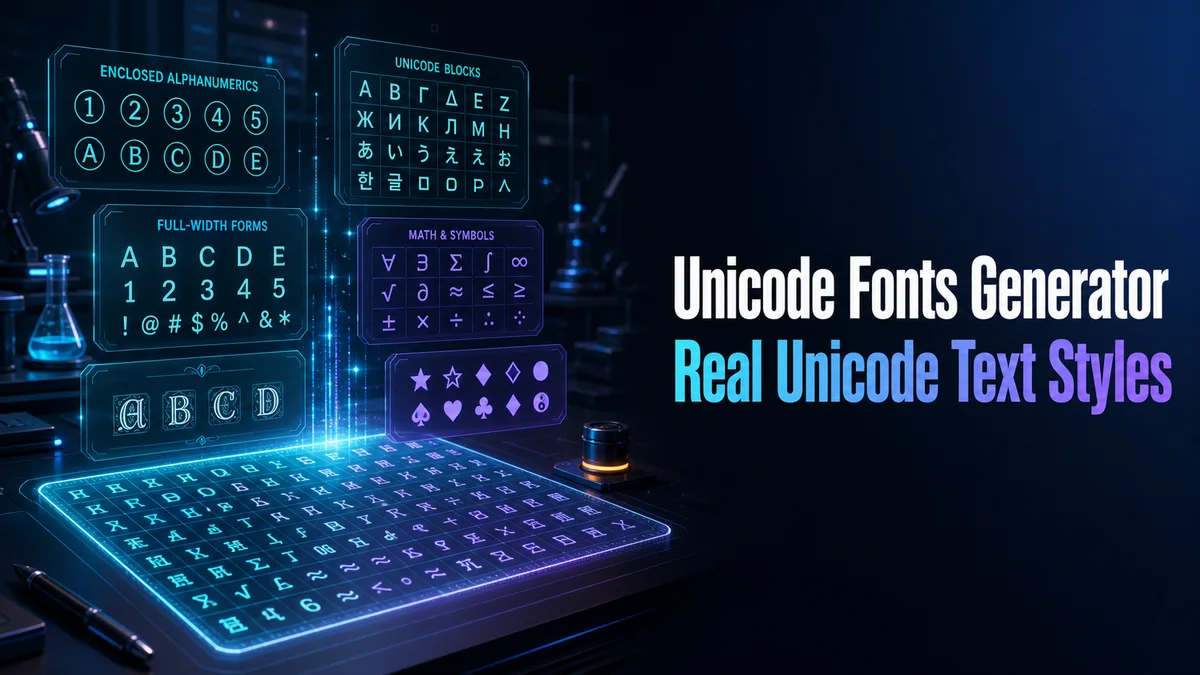
What Are Unicode Fonts?
Unicode fonts aren't really fonts. They're characters inside the Unicode standard, the system every modern device uses to store text, and they just happen to look like styled letters.
"Unicode 123" in bold becomes 𝐔𝐧𝐢𝐜𝐨𝐝𝐞 𝟏𝟐𝟑. Each bold letter is its own character with its own code.
Which Unicode Blocks Hold These Styled Characters?
Unicode groups characters into blocks, and a handful of them supply most of the styles on this page.
Mathematical Alphanumeric Symbols
This block holds bold, italic, script, gothic, outline, sans serif, and monospace letters and digits. Mathematicians use them to tell different kinds of variables apart, and they're also the source of nearly every fancy font you see on social media.
Letterlike Symbols
A few letters were added earlier in a different place. Script ℯ, ℊ, and ℴ, plus gothic ℭ, live in Letterlike Symbols. That's why they can look a touch different from their neighbors.
Enclosed Alphanumerics
Circled letters like ⓤⓝⓘ and circled numbers come from here. A related block holds squared letters and the regional indicators behind Regional Flag Blocks.
Halfwidth and Fullwidth Forms
Fullwidth letters were made for East Asian text, where each character fills a square space on the grid, and copying them over into English text is exactly what gives us the stretched-out Wide (Vaporwave) style.
Combining Marks
Combining marks are tiny marks that attach to the letter before them. Strikethrough, underline, and the marks-above styles all use them.
Why Do Unicode Letters Count Double?
Most styled letters sit outside the range that older text systems were built for. Many apps store them as two code units each, so they count twice, and a four-letter bold name like Alex takes up eight characters in the counter.
Combining marks add even more. A struck-through word carries one extra mark per letter, which doubles its length on top of everything else.
Why Do Some Unicode Fonts Show as Boxes?
A box means the device's font has no drawing for that character. Your text is stored correctly. That phone just can't show it.
Newer phones cover far more characters than old ones.
How Do Unicode Fonts Affect Search and Screen Readers?
To a search engine, 𝐀𝐥𝐞𝐱 and Alex are different strings. Styled words often don't match a plain search.
Screen readers may read each styled letter by its official name, like "mathematical bold capital A". So keep anything important plain, and use styled text for decoration only.
Related tools: Fancy Letter Generator, Font Copy Paste and Fonts Converter.
More tools like this one: Fancy Text Tools.